 Proudly Made in India


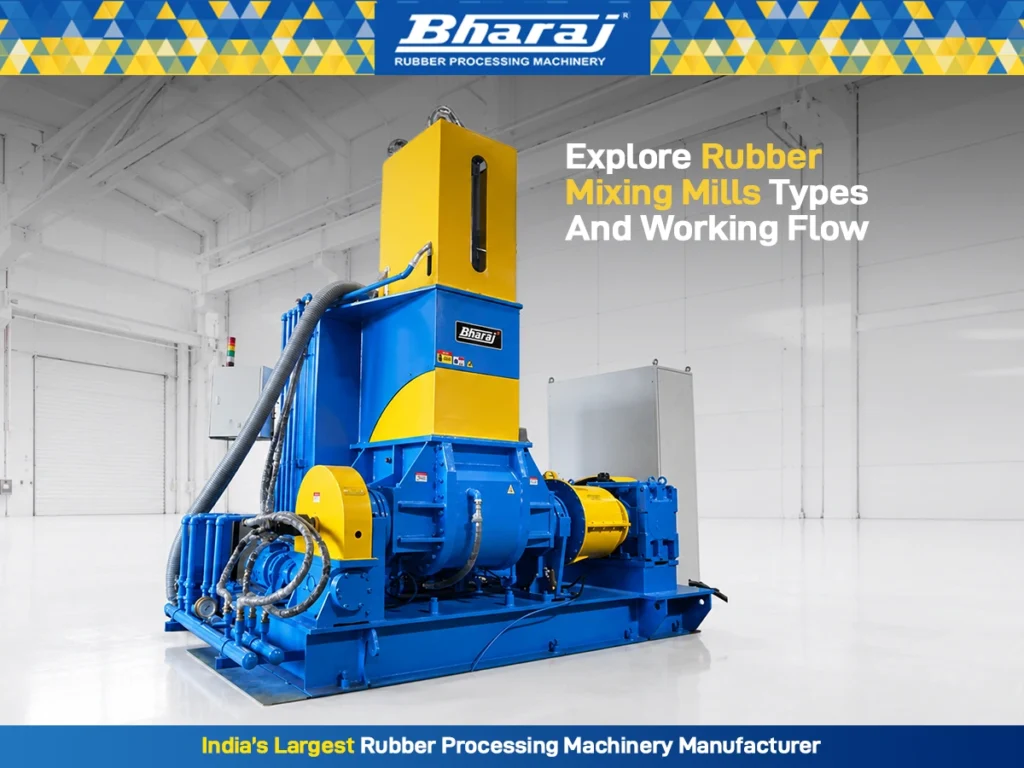
Explore Rubber Mixing Mills Types And Working Flow
The quality of every rubber product starts long before molding or extrusion. It begins during the mixing stage, where raw rubber is blended with fillers, curing agents, oils, pigments, and other additives to create a uniform compound. This critical process determines the physical properties, consistency, and overall performance of the finished product. That is why selecting the right rubber mixing mill plays a major role in modern rubber manufacturing.
Whether producing tires, industrial belts, automotive seals, hoses, gaskets, footwear components, or silicone products, manufacturers rely on efficient rubber processing machinery to achieve precise compound dispersion while maintaining productivity. As production demands continue to increase, today’s mills are designed with advanced automation, improved temperature control, enhanced safety systems, and energy-efficient technologies that support higher output with consistent quality.
This guide by Bharaj Machineries explores the different types of mills, explains how the mixing process works, discusses the latest technological advancements, and highlights the important features manufacturers should evaluate before investing in a machine. You’ll also understand how innovations such as hydraulic nip gap adjustment, peripherally drilled rolls, and hydraulic stock blenders are improving mixing efficiency across the rubber industry.
What Is A Rubber Mixing Mill?
It is an industrial machine that blends natural or synthetic rubber with chemicals, fillers, pigments, oils, and curing agents by passing the material repeatedly between two counter-rotating rolls. The continuous shearing action distributes every ingredient uniformly throughout the compound, ensuring consistent quality before the material moves to shaping or curing processes.
Unlike simple blending equipment, a modern mixing mill provides precise control over roll pressure, friction ratio, temperature, and material flow. This enables manufacturers to produce compounds that meet strict mechanical and performance requirements while reducing processing errors and materials waste.
Today, advanced mills also incorporate automation, hydraulic controls, emergency safety systems, and improved cooling mechanisms to make production safer, faster, and more energy efficient than traditional equipment.
Types Of Rubber Mixing Mills Used In Manufacturing
Different production requirements call for different machine configurations. The most commonly used types include:
| Mill Type | Best Application | Key Benefit |
|---|---|---|
| Laboratory Mill | Product development and quality testing | Small batch processing with precise formulation control |
| Conventional Two-Roll Mill | General rubber compounding | Reliable and economical for routine production |
| Hydraulic Rubber Mill | Medium to high-volume manufacturing | Accurate nip adjustment with improved operator safety |
| Variable Friction Mill | High-performance rubber compounds | Better dispersion through adjustable roll speed ratios |
| Fully Automatic Mill | Large-scale industrial production | Higher productivity with lower manual intervention |
Each configuration is designed to match specific production capacities, compound formulations, and automation requirements. Manufacturers often select equipment based on expected output, material characteristics, and operational efficiency rather than production volume alone.
Why Modern Rubber Processing Machinery Is Constantly Evolving
The rubber manufacturing industry has become increasingly quality-driven. Customers expect better product consistency, shorter delivery times, and lower production costs while complying with stricter safety standards.
To meet these expectations, manufacturers now invest in advanced processing machinery that offers the following:
- Higher mixing precision
- Reduced energy consumption
- Improved operator safety
- Lower maintenance requirements
- Better temperature management
- Faster production cycles
Modern systems also integrate hydraulic automation, intelligent control panels, automatic lubrication, emergency braking systems, and enhanced cooling technologies that improve overall manufacturing efficiency while reducing operational downtime.
Understanding The Working Flow Of A Rubber Mixing Mill
Although different machines may include varying levels of automation, the basic working flow of a mill follows a structured sequence designed to achieve uniform compound quality. Each stage plays a vital role in ensuring proper ingredient dispersion, temperature control, and batch consistency.
Step 1: Raw Material Feeding
The process begins by feeding natural or synthetic rubber onto the rotating rolls. As the rubber softens, fillers, oils, pigments, curing agents, and other additives are introduced gradually. The controlled addition of ingredients helps prevent uneven mixing while improving compound quality.
Step 2: Shearing And Blending
The counter-rotating rolls apply continuous pressure and shear force, repeatedly stretching, folding, and compressing the material. This action distributes chemicals evenly throughout the compound, ensuring every batch meets the desired specifications.
Step 3: Temperature Management
Heat naturally builds up during mixing due to friction between the rolls and the rubber compound. Modern mills use peripherally drilled rolls that circulate heating or cooling media, allowing operators to maintain stable roll temperatures. Proper temperature control helps prevent premature curing and preserves compound properties.
Step 4: Compound Discharge
Once the required dispersion and consistency are achieved, the finished compound is removed from the rolls using strip cutters or stock guides before moving to downstream operations such as extrusion, calendering, molding, or vulcanization.
Features That Improve Mixing Performance
Modern rubber processing machinery incorporates several engineering improvements that enhance production efficiency, safety, and compound quality. Instead of relying solely on mechanical adjustments, today’s equipment uses automated systems that reduce operator effort while improving process control.
Some of the most valuable features include:
- Hydraulic and motorized roll nip gap adjustment
- Variable friction and variable ratio operation
- Automatic lubrication systems
- Energy-efficient drive motors
- Heavy-duty helical gearboxes
- Pneumatic or motorized strip cutters
- Hydraulic moving stock guides
- Electromagnetic or hydraulic emergency braking systems
- Peripherally drilled rolls for improved heating and cooling
- Hydraulic stock blender for faster and more uniform mixing
Why Hydraulic Nip Gap Adjustment Matters
Among the most important improvements in modern mixing mill technology is hydraulic nip gap adjustment. Unlike conventional mechanical systems that gradually wear with continuous operation, hydraulic adjustment delivers accurate roll positioning with minimal maintenance.
Its advantages include the following:
- Reduced wear of mechanical components
- Lower maintenance and handling costs
- Accurate roll gap control
- Easier routine servicing
- Emergency roll opening during power failures
- Improved operator safety during emergencies
These benefits help manufacturers maintain consistent sheet thickness while reducing machine downtime.
Hydraulic Stock Blender Improves Mixing Quality
Many advanced mill systems are equipped with a hydraulic stock blender that continuously folds the rubber compound during mixing. Rather than depending entirely on manual handling, the stock blender assists in circulating the material more efficiently.
This provides several production advantages:
| Benefit | Production Impact |
|---|---|
| Reduced batch temperature | Better compound stability |
| Improved dispersion | More uniform ingredient distribution |
| Shorter mixing cycle | Increased production output |
| Lower operator fatigue | Safer working conditions |
| Additional cooling | Better temperature management |
Since the stock blender speed can be adjusted independently of the roll RPM, manufacturers gain greater flexibility when processing different rubber compounds.
Choosing The Right Rubber Mixing Mill
Selecting the right mill depends on more than production capacity. Manufacturers should evaluate machine construction, automation features, maintenance requirements, safety systems, and long-term operating costs before investing.
Some important considerations include:
- Batch size requirements
- Roll dimensions and friction ratio
- Energy consumption
- Temperature control capability
- Operator safety features
- Ease of maintenance
- Availability of spare parts and technical support
Choosing reliable processing machinery helps improve production efficiency while ensuring consistent product quality over the long term.
Summary
As rubber manufacturing continues to advance, modern mixing technology is becoming increasingly important for achieving higher productivity, better compound quality, and safer operations. Features such as hydraulic nip gap adjustment, peripherally drilled rolls, energy-efficient motors, and hydraulic stock blenders have transformed the way manufacturers approach rubber compounding, making today’s rubber mixing mill more efficient and reliable than ever before.
For rubber product manufacturers looking to invest in durable and high-performance mixing solutions, Bharaj Machineries is one of the top-notch rubber mixing mill manufacturers, offering an extensive range of advanced mixing mills designed for laboratory applications as well as large-scale industrial production. With robust engineering, modern automation, and decades of manufacturing expertise, our team continues to support businesses with dependable equipment built for long-term performance and consistent results.
FAQs:
1. What is a Rubber Mixing Mill?
A rubber mixing mill is a machine used to blend rubber with chemicals and additives to produce a uniform compound for further processing.
2. Why is hydraulic nip gap adjustment important?
It provides accurate roll adjustment, reduces mechanical wear, improves safety, and simplifies maintenance.
3. Which industries use rubber mixing mills?
Rubber mixing mills are widely used in tire, automotive, footwear, silicone, gasket, hose, and industrial rubber manufacturing.
4. What should you consider before buying a rubber mixing mill?
Consider production capacity, roll size, energy efficiency, safety features, automation, and maintenance requirements.
5. Why choose Bharaj Machineries?
Bharaj Machineries offers heavy-duty, energy-efficient rubber mixing mills with advanced safety features, hydraulic technology, and reliable after-sales support for diverse manufacturing needs.