 Proudly Made in India


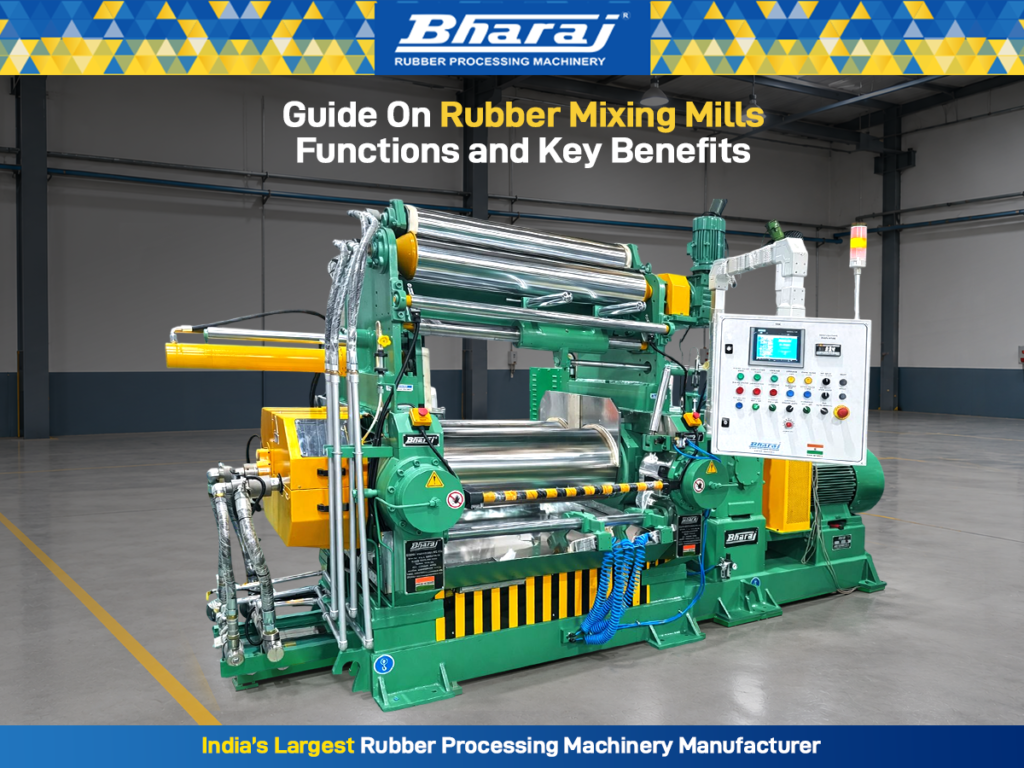
Guide On Rubber Mixing Mills Functions And Key Benefits
Have you ever wondered what determines the quality, durability, and consistency of rubber products before they reach the market? The answer often lies in the efficiency of the rubber mixing mill, one of the most critical pieces of equipment in rubber processing. From automotive components to industrial seals, achieving a uniform rubber compound begins with the right mixing process.
As global industries continue to demand high-performance rubber products, manufacturers are investing in advanced processing technologies that improve productivity and compound quality. Industry experts highlight that modern mixing systems are increasingly incorporating automation, enhanced temperature control, and energy-efficient designs to meet evolving production requirements. In this guide, Bharaj Machineries will help you understand the functions, working principles, and advantages of these
What Is A Rubber Mixing Mill?
It is an industrial machine designed to blend raw rubber with additives such as fillers, chemicals, accelerators, and curing agents to create a uniform compound. Traditionally built with two essential machines in today’s rubber manufacturing landscape, counter-rotating rolls, this equipment applies pressure and shear force to break down materials and disperse ingredients evenly.
The final compound produced during this stage directly affects the performance of products such as the following:
- Tires
- Conveyor belts
- Rubber sheets
- Gaskets and seals
- Industrial hoses
- Footwear components
Without proper mixing, manufacturers risk inconsistencies that can impact product durability and safety.
How Does A Rubber Mixing Mill Work?
The operation of a rubber mixing machine follows a structured process that ensures ingredients are evenly distributed throughout the rubber batch.
Step 1: Material Feeding
Raw rubber is introduced between two rotating rollers. Various additives required for the formulation are gradually added.
Step 2: Shearing And Kneading
As the rolls rotate at different speeds, they generate friction and compression. This action stretches, folds, and kneads the material repeatedly.
Step 3: Temperature Regulation
The prepared silicone compound enters the extruder, where a rotating screw pushes the material forward under controlled pressure.
As the silicone moves through the machine, it is forced through a precision die that determines the profile shape.
This stage is critical because even slight variations can affect dimensional accuracy.
Industry specialists emphasize that accurate die design significantly improves consistency in extruded silicone rubber products.
Step 4: Compound Collection
Once the required consistency is achieved, the compound is removed for downstream operations such as extrusion, molding, or calendaring.
This systematic approach allows the machine to produce reliable compounds suitable for demanding industrial applications.
Key Functions Of Rubber Mixing Mills
The primary role of these machines extends beyond simple blending. A well-designed system contributes significantly to production efficiency and material performance.
1. Uniform Dispersion Of Ingredients
One of the most important functions of a mill is ensuring all ingredients are distributed evenly throughout the compound.
This uniformity helps achieve the following:
- Consistent hardness
- Improved elasticity
- Reliable tensile strength
- Better product performance
Industries such as automotive manufacturing rely heavily on this consistency to maintain strict quality standards.
2. Plasticizing Raw Rubber
Raw rubber can be difficult to process due to its natural elasticity.
A mixing mill softens and plasticizes the material, making it easier to combine with other ingredients and shape during subsequent manufacturing stages.
Benefits Of Plasticization include:
- Improved workability
- Enhanced additive absorption
- Greater processing flexibility
- Reduced material resistance
3. Compound Development And Customization
Different products require unique formulations.
Manufacturers use a mixing mill machine to adjust recipes based on specific performance requirements, including:
- Heat resistance
- Oil resistance
- Abrasion resistance
- Flexibility
- Weather durability
This customization enables businesses to cater to various industries with precision-engineered rubber compounds.
4. Improving Material Properties
Effective mixing contributes directly to the mechanical characteristics of the finished product.
Proper processing enhances:
- Strength
- Elasticity
- Longevity
- Resistance to wear
- Overall reliability
Industry guidance consistently emphasizes that superior mixing quality results in better-performing rubber products across sectors.
5. Supporting High-Volume Production
Modern facilities require equipment capable of handling continuous production demands.
An advanced rubber mixing machine enables manufacturers to process larger batches efficiently while maintaining quality standards.
Advantages include:
- Faster throughput
- Reduced downtime
- Improved operational efficiency
- Lower production costs
As automation becomes more common, manufacturers are increasingly adopting intelligent control systems to optimize productivity.
Comparison Of Traditional And Advanced Mixing Solutions
The evolution of mixing technology has transformed rubber manufacturing processes.
Feature | Traditional Equipment | Modern Mixing Systems |
Temperature Control | Manual monitoring | Automated regulation |
Batch Consistency | Operator-dependent | Highly consistent |
Production Efficiency | Moderate | High |
Energy Consumption | Relatively higher | More optimized |
Safety Features | Basic mechanisms | Enhanced protection systems |
Process Monitoring | Limited | Real-time tracking |
Maintenance Planning | Reactive | Preventive support |
The growing adoption of modern systems reflects the industry’s focus on productivity, safety, and precision.
Why Are Mixing Mills Important?
Rubber Processing Demands Accuracy At Every Stage
A dependable mill machine for mixing ensures manufacturers can maintain quality standards while adapting to changing production requirements. Whether producing large industrial components or specialty rubber products, the effectiveness of the mixing process significantly influences the final outcome.
Key Benefits Of Mills For Manufacturers
Investing in the right processing equipment can significantly influence productivity, product quality, and operational efficiency. Beyond blending compounds, these machines contribute to long-term business performance.
Improved Compound Consistency
Consistency is one of the biggest challenges in rubber manufacturing. Variations in ingredient distribution can lead to product defects and quality issues.
A well-designed mixing mill ensures uniform dispersion throughout the batch, helping manufacturers maintain strict quality standards and reduce material rejection rates.
Enhanced Production Efficiency
Modern systems are built to handle demanding production schedules while minimizing interruptions.
Key efficiency benefits include the following:
- Faster batch preparation.
- Reduced processing errors.
- Better material utilization.
- Improved workflow continuity.
Industry experts note that optimized mixing processes can significantly improve throughput while maintaining compound quality.
Better Product Performance
The quality of the compound directly affects the performance of the final product.
Effective mixing contributes to:
- Higher tensile strength.
- Improved elasticity.
- Enhanced abrasion resistance.
- Greater durability.
Whether producing automotive components or industrial products, reliable mixing remains essential for achieving consistent results.
Operational Flexibility
Different applications require different formulations.
A dependable mixing mill machine allows manufacturers to adapt production according to changing market demands without compromising quality.
This flexibility supports the production of:
- Natural rubber compounds.
- Synthetic rubber formulations.
- Specialty industrial materials.
- Customized performance products.
Factors To Consider Before Buying A Mill
Selecting the right equipment involves evaluating both current production requirements and future business goals.
Production Capacity
Assess your daily output requirements and expected growth. Machines should align with batch sizes and production volumes.
Temperature Control Systems
Controlled cooling systems maintain optimal temperatures throughout processing. Proper temperature management helps prevent scorching and ensures consistent quality.
Safety Features
Operator safety should never be overlooked.
Look for features such as:
- Emergency stop systems.
- Safety trip bars.
- Protective guards.
- Reliable braking mechanisms.
Build Quality
High-quality construction improves machine longevity and minimizes maintenance requirements.
After-Sales Support
Reliable service and technical assistance contribute significantly to long-term operational success.
When evaluating rubber mixing mill manufacturers, businesses should prioritize experience, product reliability, and responsive customer support.
Applications Across Industries
Rubber compounds produced using these machines support a wide range of sectors.
Common applications include:
- Automotive manufacturing.
- Conveyor belt production.
- Footwear manufacturing.
- Cable insulation.
- Medical equipment components.
- Industrial seals and gaskets.
Because different industries demand varying performance characteristics, a versatile rubber mixing machine becomes a valuable asset across production environments.
Why Businesses Choose Bharaj Machineries
Choosing industrial equipment involves more than comparing specifications. Manufacturers seek partners who understand operational challenges and provide dependable solutions.
Their team focus extends beyond supplying machinery. Businesses benefit from equipment designed to support efficiency, consistency, and durability within demanding production settings.
Organizations often value:
- Robust machine construction.
- Performance-driven engineering.
- Reliable operational support.
- Solutions tailored to production requirements.
- Long-term value and dependability.
As industries continue to prioritize quality and productivity, their team remains committed to supporting manufacturers with solutions designed for evolving market needs.
Summary:
A rubber processing operation is only as effective as the equipment supporting it. From ensuring uniform ingredient dispersion to improving compound performance and enhancing operational efficiency, the rubber mixing mill continues to play a critical role in modern manufacturing.
As customer expectations and quality standards rise, businesses must invest in equipment that delivers precision, reliability, and flexibility. By understanding the functions, advantages, and selection criteria of these systems, manufacturers can make informed decisions that enhance productivity and long-term growth.
If you’re planning to upgrade your processing capabilities, choosing the right machinery today can create a stronger foundation for tomorrow’s manufacturing success.
FAQs:
What is the primary function of a rubber mixing mill?
Its primary role is to blend rubber with additives uniformly to create high-quality compounds suitable for various manufacturing applications.
How is a mixing mill different from other rubber processing equipment?
A mixing mill uses two rotating rolls to plasticize and disperse ingredients, providing operators with greater control over compound preparation.
What factors should I consider before buying a mixing mill machine?
Key considerations include production capacity, temperature control, safety features, build quality, and after-sales support.
Can a rubber mixing machine handle different rubber compounds?
Yes. Modern equipment can process both natural and synthetic rubber formulations used across diverse industries.
Why is choosing experienced rubber mixing mill manufacturers important?
Experienced suppliers offer better engineering expertise, dependable support, and equipment designed to deliver consistent performance over time.