 Proudly Made in India


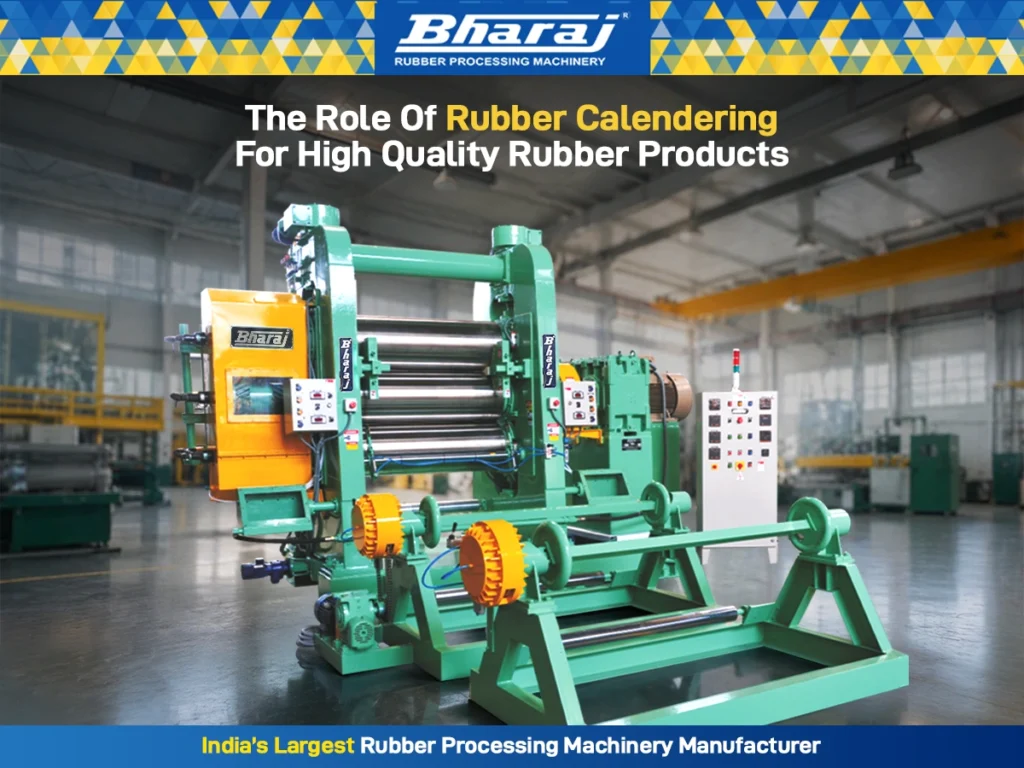
The Role Of Rubber Calendering For High-Quality Rubber Products
Rubber manufacturing demands consistency, precision, and excellent surface quality. Whether producing automotive components, conveyor belts, industrial sheets, footwear materials, or coated fabrics, every product relies on a uniform rubber sheet as its foundation. This is where rubber calendering becomes an essential step in the manufacturing process.
Modern rubber calendars are designed to compress, smooth, and refine rubber compounds into sheets of controlled thickness while eliminating air pockets and improving surface finish. As production standards continue to rise across industries, manufacturers increasingly depend on advanced rubber calendar machine technology to achieve repeatable quality, reduce material waste, and improve production efficiency.
This blog by Bharaj Machineries explains how rubber calendering works, why it is important for producing premium rubber products, the technologies that improve sheet quality, and the machine features manufacturers should evaluate before investing in new rubber processing machinery.
What Is Rubber Calendering?
Rubber calendering is the process of passing a mixed rubber compound through a series of precision-engineered rotating rolls that compress and shape the material into sheets of uniform thickness. Depending on the application, the process may also bond rubber with textile fabrics through topping or sticking operations.
Unlike simple rolling, modern rubber calendars perform several functions simultaneously:
- Produce smooth and uniform rubber sheets
- Remove trapped air before vulcanization
- Improve sheet thickness accuracy
- Enhance surface finish
- Prepare compounds for downstream manufacturing
The number of rolls used directly influences the quality of the finished sheet. Multiple-roll systems allow repeated pressing, resulting in better thickness control and improved consistency.
Why Rubber Calendering Is Essential For High-Quality Rubber Products
A high-quality rubber product begins with a perfectly prepared sheet. Even minor variations in thickness or trapped air can affect durability, flexibility, and overall product performance.
An advanced calendar machine helps manufacturers achieve the following:
- Uniform sheet thickness
- Better dimensional accuracy
- Improved surface finish
- Air bubble elimination
- Consistent compound density
- Better bonding with reinforcement fabrics
These benefits make calendering one of the most important stages before molding, extrusion, tire manufacturing, and industrial rubber fabrication.
How A Rubber Calendar Machine Works
The rubber compound first enters the rotating rolls after being mixed and refined. As it passes repeatedly through the rollers, controlled pressure compresses the material into a smooth sheet while maintaining the required thickness.
Modern systems also support:
- Single and double sticking operations
- Textile fabric topping
- Rubber/EVA lamination
- PVC sheet production
- Sponge insole manufacturing
- Tyre topping applications
The carefully controlled roll pressure in rubber calendars ensures excellent sheet quality while maintaining production efficiency.
Key Features That Improve Rubber Calendering Performance
Modern calendar machine technology is built to deliver more than smooth rubber sheets. It focuses on precision, productivity, operator safety, and long-term reliability. Features such as hydraulic control systems, optimized roll configurations, and advanced temperature management enable manufacturers to produce consistent rubber sheets while minimizing defects and material waste.
Some of the most valuable features of rubber calenders include the following:
- High-precision hydraulic nip control
- Servo-controlled operation for accurate sheet thickness
- Multiple roll configurations for different applications
- Rugged steel construction for long service life
- Uniform pressure distribution
- Air bubble elimination during sheeting
- High production efficiency with simple operations
Why Roll Configuration Matters
The number and arrangement of rolls directly affect sheet quality and production capability. More rolls allow the compound to be pressed multiple times, resulting in better surface finish and more consistent thickness.
Different roll configurations are suitable for applications such as the following:
| Roll Configuration | Common Application | Main Advantage |
|---|---|---|
| 2-Roll | Basic rubber sheeting | Simple and economical |
| 3-Roll | Rubber-coated fabrics | Improved thickness control |
| 4-Roll | Precision sheet production | Superior surface finish |
| Multi-Roll | High-volume industrial production | Maximum uniformity and productivity |
Modern rubber calendars are designed with flexible roll arrangements to support PVC sheets, synthetic rubber, tire topping, sponge insoles, footwear components, and technical rubber products.
Advanced Features That Improve Sheet Quality
Several engineering innovations help modern rubber calendars produce premium rubber sheets.
Zero Clearance Device
When high pressure is applied, rolls can experience slight deflection that affects sheet thickness. A zero-clearance device compensates for this strain, maintaining uniform pressure across the roll surface and producing consistently even sheets.
Drilled Rolls
Peripherally drilled rolls improve heating and cooling performance by distributing temperature evenly across the roll surface. This minimizes temperature variation, improves rigidity, reduces roll deflection, and delivers more stable sheet quality during continuous production.
Hydraulic Nip Control
Hydraulic nip adjustment enables precise control over roll pressure, allowing manufacturers to achieve accurate sheet thickness with minimal manual intervention. Servo-controlled systems further improve production consistency while reducing setup time.
Applications Across Multiple Industries
Modern calendar machine systems support a wide range of manufacturing processes beyond simple rubber sheeting. Their versatility makes them an essential part of today’s rubber processing machinery.
Common applications include:
- Tyre topping
- Conveyor belts
- Industrial rubber sheets
- Rubber-coated textile fabrics
- PVC sheet manufacturing
- Sponge insole production
- Ball tubes
- Footwear components
- Synthetic rubber products
Choosing The Right Rubber Calendar Machine
Selecting the right calendaring system depends on production goals, product specifications, and long-term operational efficiency rather than machine size alone.
Before investing, manufacturers should evaluate:
- Required production capacity
- Roll size and configuration
- Hydraulic control capability
- Temperature management system
- Construction quality
- Ease of maintenance
- Energy efficiency
- Availability of technical support
Working with an experienced rubber product manufacturer also ensures access to reliable equipment, installation support, and long-term, uninterrupted production.
Summary
Rubber calendering plays a vital role in producing smooth, accurate, and defect-free rubber sheets that directly influence the quality of finished products. From advanced hydraulic nip control to precision roll configurations and drilled roll technology, rubber calendars help manufacturers improve productivity while maintaining exceptional consistency. These innovations continue to raise quality standards across the global rubber industry.
For manufacturers seeking reliable calendaring solutions, Bharaj Machineries offers advanced rubber calendaring systems engineered for precision, durability, and long-term performance. As a trusted manufacturer and rubber machinery exporter, our team continues to deliver innovative solutions that support efficient production and consistently high-quality rubber products across diverse industrial applications.
FAQs:
1. What is the role of a rubber calendar machine in rubber manufacturing?
A rubber calendar machine compresses and smooths rubber compounds into uniform sheets, removes trapped air, and prepares materials for applications such as tire components, coated fabrics, footwear, and industrial rubber products.
2. Which industries commonly use rubber calendars?
Rubber calendars are widely used in the automotive, tire, footwear, conveyor belt, PVC sheet, industrial rubber, and textile coating industries where consistent sheet quality is essential.
3. Why is hydraulic nip control important in a rubber calendar machine?
Hydraulic nip control maintains accurate roll pressure, improves sheet thickness consistency, enhances product quality, and reduces manual adjustment during production.
4. What should manufacturers consider before investing in rubber processing machinery?
Key considerations include production capacity, roll configuration, machine durability, precision control systems, energy efficiency, maintenance requirements, and after-sales support from a reliable rubber machinery exporter.
5. Why choose Bharaj Machineries for rubber calendaring solutions?
Bharaj Machineries offers precision-engineered calendaring systems with rugged construction, hydraulic controls, multiple roll configurations, and reliable performance for producing high-quality rubber sheets across various industrial applications.