 Proudly Made in India


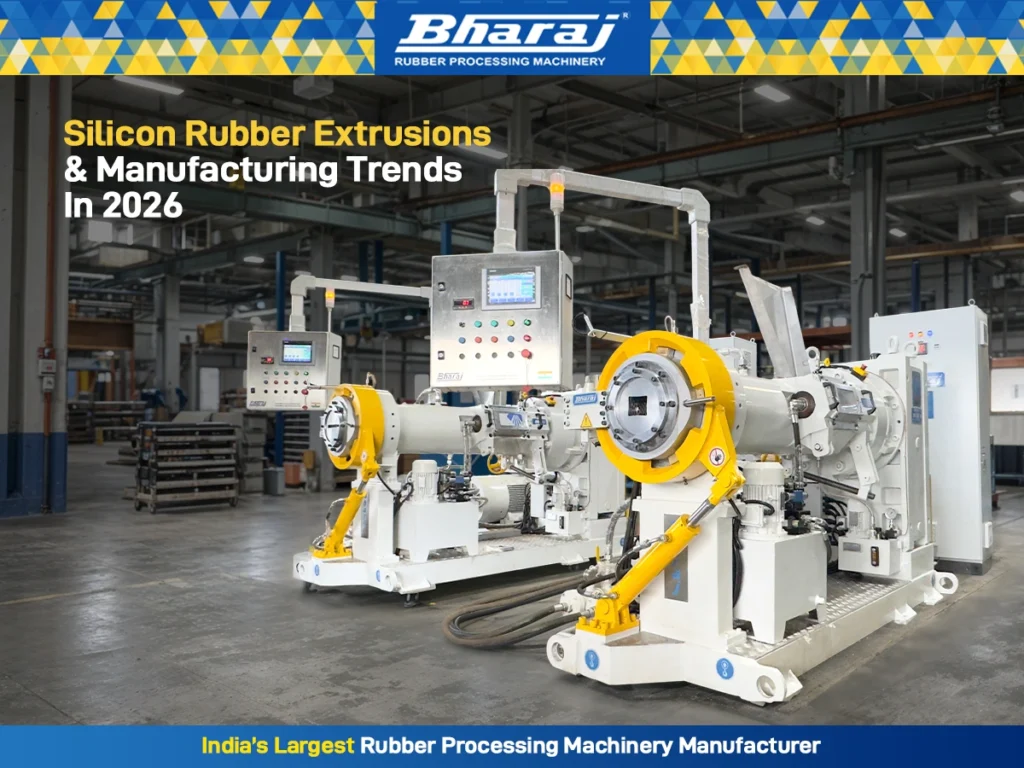
Silicone Rubber Extrusions & Manufacturing Trends In 2026
Silicone has become one of the most dependable materials for applications that demand flexibility, durability, and resistance to extreme operating conditions. From automotive sealing systems and medical tubing to electrical insulation and food-grade equipment, silicone rubber extrusions are essential for products that require consistent performance over long service lives.
As manufacturing standards continue to evolve, Bharaj Machineries is investing in advanced extrusion technology that delivers tighter dimensional tolerances, improved process stability, and higher production efficiency. Modern extrusion systems are no longer designed simply to increase output. They focus on maintaining consistent material flow, reducing downtime, and producing high-quality profiles with minimal variation.
The growing demand for precision silicone components is driving innovation across automotive, healthcare, electronics, renewable energy, and industrial manufacturing. To meet these requirements, machinery manufacturers are developing specialized equipment that addresses the unique processing characteristics of silicone compounds while improving operational reliability.
What Are Silicone Rubber Extrusions?
Silicone rubber extrusions are continuous profiles manufactured by forcing uncured silicone rubber through a precision die before the material undergoes curing or vulcanization. This process produces products with uniform cross-sections, making it ideal for manufacturing tubing, seals, gaskets, cords, and custom industrial profiles.
Unlike many conventional rubber compounds, silicone is naturally soft and highly adhesive. These properties make processing more challenging and require machinery specifically engineered to maintain stable extrusion pressure, controlled material feeding, and dimensional accuracy throughout production. Standard rubber extruders often cannot provide the consistency needed for silicone processing, making specialized extrusion equipment an important investment for manufacturers producing extruded silicone rubber products.
Why Specialized Silicone Extrusion Technology Matters
Although silicone is valued for its excellent resistance to heat, chemicals, UV exposure, and aging, its processing characteristics present unique engineering challenges.
Its sticky consistency can make feeding, cleaning, and color or compound changeovers significantly more demanding than conventional rubber processing. Modern extrusion systems address these issues through specialized machine designs that improve stability and production efficiency.
Key engineering features include:
- Hardened feed rollers for accurate strip feeding
- Optimized screw and barrel configurations
- Stable extrusion pressure throughout production
- Water circulation systems for effective temperature control
- Sliding screw and barrel arrangements for faster cleaning during compound changes
These innovations help manufacturers produce extrusions with greater dimensional consistency while minimizing downtime and reducing material waste.
Industries Driving Demand In 2026
Demand for silicone components continues to increase as industries require materials capable of performing reliably in demanding environments.
Automotive Manufacturing
Electric vehicles and conventional automobiles rely on silicone for applications requiring flexibility, heat resistance, and long-term durability.
Common applications include:
- Battery pack seals
- Weather strips
- Cable protection
- Door and window gaskets
Healthcare And Medical
Medical-grade silicone remains a preferred material because of its biocompatibility and ability to withstand repeated sterilization.
Typical applications include the following:
- Medical tubing
- Catheters
- Laboratory equipment
- Fluid transfer systems
Electronics And Electrical Systems
Manufacturers use extruded silicone rubber for insulation and protective components because it maintains flexibility while providing reliable electrical performance.
Common applications include:
- Wire insulation
- Cable sleeves
- Connector seals
- Protective covers
Food Processing And Industrial Equipment
Food-grade silicone profiles are widely used for hygienic sealing systems, while industrial manufacturers rely on silicone for vibration control, machinery protection, and sealing applications requiring long-term durability.
Emerging Manufacturing Trends In 2026
The silicone extrusion industry is shifting its focus from simply increasing output to improving process stability, precision, and operational efficiency. Modern production lines are designed to maintain consistent material flow, reduce downtime, and deliver high-quality rubber extrusions with minimal dimensional variation.
Intelligent Process Monitoring
Advanced extrusion systems now integrate digital controls that continuously monitor extrusion pressure, material flow, and operating temperatures. Real-time monitoring helps identify process variations early, enabling manufacturers to improve product consistency while reducing waste and production errors.
Advanced Feeding Systems
Consistent feeding is one of the most important factors in silicone processing. Since silicone compounds are soft and highly adhesive, uneven feeding can result in pressure fluctuations and inconsistent product dimensions.
Modern extrusion machines overcome these challenges with hardened feed rollers and specially engineered spiral undercut feeding arrangements that ensure a smooth and uniform supply of material into the screw. This helps maintain stable extrusion pressure throughout the production cycle.
Key advantages include the following:
- Better profile accuracy
- Improved surface finish
- Stable extrusion pressure
- Reduced material waste
These engineering improvements enable manufacturers to produce silicone rubber with greater consistency over extended production runs.
Efficient Cooling For Continuous Production
Continuous extrusion generates heat that can affect processing stability if not properly controlled. Modern silicone extrusion systems incorporate water circulation through rotary pressure joints to maintain consistent operating temperatures during long production cycles.
Combined with optimized screw designs and efficient feeding mechanisms, these cooling systems ensure smooth material transfer, eliminate feed irregularities, and support uniform profile formation. The result is higher production efficiency and improved product quality.
Benefits Of Modern Silicone Extrusion Technology
| Feature | Manufacturing Benefit |
|---|---|
| Hardened feed rollers | Accurate and consistent material feeding |
| Stable extrusion pressure | Improved product consistency |
| Water circulation cooling | Reliable continuous production |
| Quick-clean screw and barrel design | Reduced downtime during colour or compound changes |
| Precision engineering | Better dimensional accuracy and lower rejection rates |
Choosing The Right Silicone Extrusion Manufacturers
Selecting experienced extrusion manufacturers is essential for achieving consistent production quality and long-term operational efficiency. Beyond machine specifications, businesses should evaluate a supplier’s engineering expertise, process knowledge, and after-sales support.
When comparing suppliers, consider:
- Experience in silicone processing technology
- Machine designs that ensure stable feeding and extrusion
- Efficient cleaning and maintenance features
- Proven engineering capabilities
- Installation, commissioning, and technical support
- Long-term service and process optimization
Reliable extrusion manufacturers continuously improve machine designs to help businesses produce high-quality silicone rubber extrusions, reduce downtime, and maximize productivity.
Common Applications Of Extruded Silicone Rubber
The versatility of this rubber makes it suitable for industries where flexibility, durability, and resistance to demanding operating conditions are essential. When manufactured using stable extrusion systems, silicone profiles maintain consistent dimensions and high-quality surface finishes, meeting the strict requirements of modern industrial applications.
Common applications include:
- Automotive seals, battery gaskets, and cable protection
- Medical tubing, catheters, and laboratory equipment
- Electrical insulation, connector seals, and cable sleeves
- Food-grade sealing systems and industrial machinery protection
The growing use of silicone across these sectors continues to increase demand for precision silicone rubber extrusions that can perform reliably over long service lives.
Why Bharaj Machineries Supports Modern Silicone Manufacturing
Modern manufacturing demands more than standard extrusion equipment. It requires machinery engineered specifically for the unique processing characteristics of silicone compounds.
Bharaj Machineries develops extrusion systems that incorporate hardened feed rollers, optimized feeding arrangements, water circulation systems, and quick-clean screw and barrel designs. These features help maintain stable extrusion pressure, improve material flow, and reduce downtime during color or compound changeovers. As a result, manufacturers can produce consistent silicone rubber extrusions while improving operational efficiency and minimizing material waste.
In addition to machinery, Bharaj Machineries provides engineering support, installation assistance, and process guidance to help manufacturers achieve reliable long-term production performance across automotive, healthcare, electrical, food processing, and industrial applications.
Summary
The future of silicone rubber extrusions is being shaped by advanced engineering, intelligent process control, and equipment designed specifically for silicone processing challenges. Manufacturers are increasingly investing in technologies that improve feeding accuracy, stabilize extrusion pressure, and reduce production downtime while maintaining consistent product quality.
The expanding use of silicone rubber across automotive, medical, electrical, food processing, and industrial sectors highlights the importance of specialized extrusion systems. At the same time, Bharaj Machineries, one of the experienced silicone extrusion manufacturers, continues adopting smarter machine designs that enhance efficiency while maintaining tight dimensional tolerances and reliable long-term performance.
By combining process expertise with precision-engineered equipment, manufacturers can improve product quality, optimize resource utilization, and remain competitive as industry requirements continue to evolve through 2026 and beyond.
FAQs:
1. What are silicone rubber extrusions?
Silicone rubber extrusions are continuous silicone profiles produced by forcing uncured silicone through a precision die before curing. They are commonly used for seals, tubing, gaskets, and industrial profiles.
2. Why do silicone extrusion manufacturers use specialized machinery?
Because silicone is soft and highly adhesive, it requires extrusion systems with precise feeding, stable pressure, and efficient cleaning mechanisms to maintain product quality and production efficiency.
3. What industries commonly use extruded silicone rubber?
Automotive, healthcare, electronics, food processing, construction, and industrial manufacturing all rely on extruded silicone rubber because of its flexibility, heat resistance, and durability.
4. How does automation improve silicone extrusion?
Automation enables real-time monitoring, stable material flow, reduced waste, improved dimensional accuracy, and higher production consistency.
5. What should businesses consider when selecting silicone extrusion manufacturers?
Businesses should evaluate engineering expertise, process stability, machine quality, maintenance features, technical support, and the supplier’s ability to deliver consistent production performance.