 Proudly Made in India


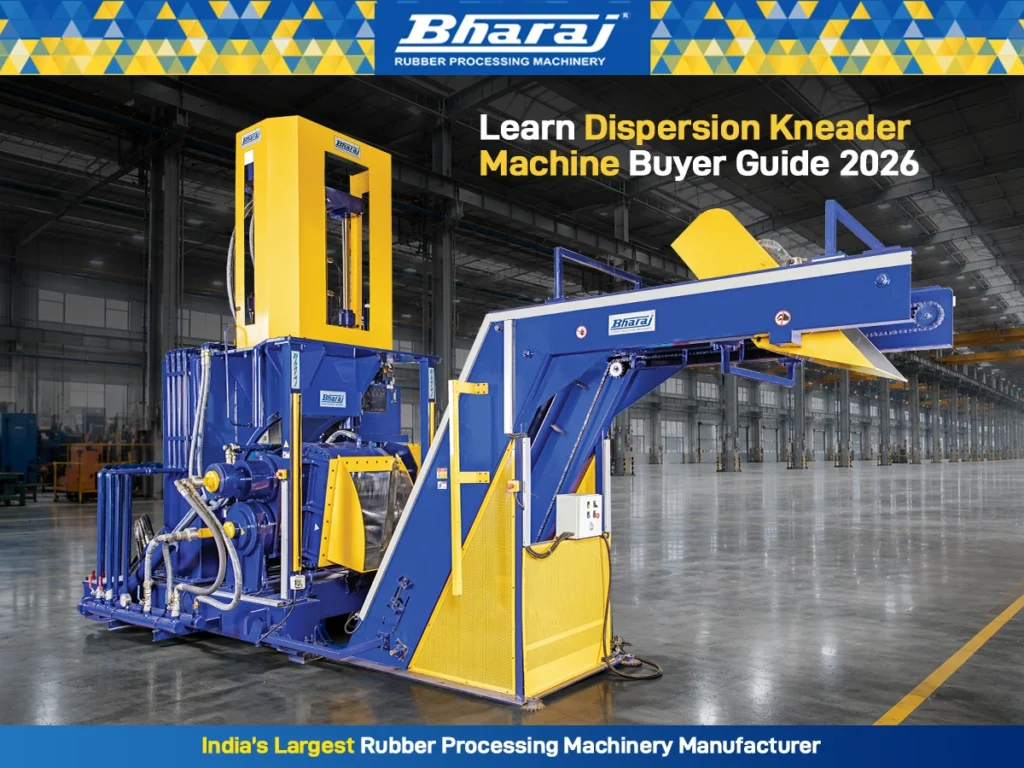
Learn Dispersion Kneader Machine Buyer Guide 2026
As rubber compounds become more advanced and production standards continue to rise, manufacturers need mixing equipment that delivers consistent quality, faster production, and greater process control. Investing in the right dispersion kneader machine is no longer just about increasing output. It is about improving compound uniformity, reducing material waste, lowering operating costs, and maintaining product consistency across every batch. Industries producing hoses, automotive components, conveyor belts, silicone products, EVA compounds, footwear, and industrial rubber goods all rely on efficient mixing technology to stay competitive.
This comprehensive buyer guide explains everything manufacturers should evaluate before purchasing a dispersion kneader machine in 2026. Drawing insights from industry best practices while highlighting the engineering strengths of Bharaj Machineries, this guide will help you understand machine construction, rotor selection, capacity planning, cooling systems, and the features that truly influence long-term productivity. A well-informed investment today can significantly improve production efficiency for years to come.
Why Is A Dispersion Kneader Machine Essential?
It is a closed mixing system that blends rubber polymers with fillers, oils, chemicals, pigments, carbon black, and other additives under controlled pressure and temperature. Unlike open mills that depend heavily on operator experience, the enclosed chamber generates higher shear forces, producing more uniform dispersion while minimizing contamination and material loss.
Modern manufacturers increasingly prefer a dispersion kneader because it offers the following:
- Better ingredient dispersion
- Higher batch consistency
- Faster mixing cycles
- Improved temperature control
- Lower labour dependency
- Cleaner, dust-free production
- Reduced raw material wastage
For manufacturers working with specialty compounds or frequent formulation changes, these benefits directly improve production quality and profitability.
Applications Across Modern Rubber Manufacturing
Before purchasing any rubber kneader machine, buyers should confirm whether the equipment supports both current production needs and future expansion.
Our Super Mix Kneader is suitable for processing the following:
- Rubber hose compounds
- Silicone rubber
- Conveyor belts
- Gaskets and seals
- Sponge rubber
- Footwear soles and sandals
- Automotive mechanical goods
- Master batches
- EVA compounds
- Phenol compounds
- Polythene compounds
- Thermoplastic resins
This wide processing capability allows manufacturers to use one machine across multiple production lines while maintaining consistent compound quality.
Questions Every Buyer Should Ask Before Purchasing
Every factory has unique production requirements. Instead of focusing only on purchase price, evaluate the machine from both technical and operational perspectives.
| Buying Factor | Why It Matters |
|---|---|
| Production capacity | Ensures the machine matches daily batch requirements without unnecessary operating costs. |
| Rotor configuration | Influences mixing efficiency, shear force, and final compound quality. |
| Cooling system | Maintains stable temperatures and prevents compound degradation. |
| Hydraulic tilting | Simplifies discharge and reduces cleaning time between batches. |
| Dust control | Minimizes ingredient loss while improving workplace safety. |
| Maintenance requirements | Lower maintenance means reduced downtime and higher productivity. |
| Future scalability | Supports increasing production demands without replacing equipment. |
Selecting equipment using these criteria results in better long-term returns than comparing machines purely by initial cost.
Features That Define A High-Performance Dispersion Kneader
A premium kneader machine for dispersion combines mechanical strength with intelligent engineering. Our Super Mix Kneader incorporates several productivity-focused features that modern manufacturers should prioritize when comparing machines.
Key features include the following:
- Superior dispersion performance
- Maximum cooling efficiency
- Quick cleaning design
- Single-pass mixing capability
- Shorter mixing cycles
- Multiple rotor configurations
- Optional drop-door discharge
- Hydraulic tilting system
Together, these features reduce production delays while ensuring excellent compound uniformity throughout every mixing cycle.
Hydraulic Tilting Makes Production Easier
One of the most practical innovations in today’s rubber kneader machine technology is hydraulic tilting. Unlike conventional discharge systems that rely on mechanical movement, hydraulic tilting enables smooth unloading with minimal maintenance.
Its advantages include the following:
- Faster discharge of finished compounds
- Easier chamber cleaning
- Lower maintenance requirements
- Improved operator safety
- Better overall production efficiency
For facilities running continuous production or frequent material changes, hydraulic tilting significantly reduces downtime between batches.
Superior Mixing Through Advanced Rotor Design
Rotor geometry directly influences how efficiently fillers and additives disperse throughout the rubber compound. This is why leading kneader manufacturers offer multiple rotor configurations for different applications.
Our team provides options such as the following:
- Tri-Blade Rotors
- Tangential Rotors
- Intermeshing Rotors
Each design delivers different mixing characteristics depending on compound formulation, production volume, and required dispersion quality. Intermeshing rotors, for example, provide exceptional mixing consistency for demanding industrial applications by generating controlled shear throughout the mixing chamber.
Mixing Chamber Construction Matters
The durability of a dispersion kneader depends heavily on its mixing chamber design.
Our chamber is manufactured using fabricated alloy steel with hard-faced wear surfaces. It features longitudinal and transverse water jackets for effective cooling and steam heating while being capable of hydraulic tilting up to 130 degrees for easier discharge.
This construction offers:
- Excellent wear resistance
- Better heat transfer
- Consistent temperature control
- Longer machine lifespan
- Easier cleaning after production
Maintaining stable temperatures during kneading helps prevent compound degradation while improving final product quality across every production batch.
Choosing The Right Machine Capacity For Your Production
Selecting the correct dispersion kneader machine capacity is just as important as choosing the right features. An undersized machine can create production bottlenecks, while an oversized system increases energy consumption and operating costs. The ideal choice depends on your batch size, compound formulation, production frequency, and future expansion plans.
Modern manufacturers should always evaluate current output requirements while leaving room for business growth. Industry experts also recommend matching motor power and chamber volume with production goals rather than focusing only on purchase price.
We offer a comprehensive BMK series that serves both medium and large-scale rubber processing industries:
| Model | Working Capacity | Main Motor | Suitable For |
|---|---|---|---|
| BMK-05 | 5 Litres | 10 HP | Laboratory trials & R&D |
| BMK-10 | 10 Litres | 20 HP | Small-batch production |
| BMK-25 | 20 Litres | 30 HP | Medium rubber compounds |
| BMK-35 | 35 Litres | 60 HP | Industrial production |
| BMK-55 | 55 Litres | 75 HP | Large batch processing |
| BMK-75 | 75 Litres | 125 HP | High-volume manufacturing |
| BMK-110 | 120 Litres | 200 HP | Heavy industrial applications |
| BMK-150 | 150 Litres | 200 HP | Continuous large-scale production |
Why Bharaj Super Mix Technology Stands Out
A modern rubber kneader machine should deliver far more than mixing power. It should improve production efficiency while reducing labor, cleaning time, and operating costs.
The Super Mix Kneader has been engineered for manufacturers handling demanding compounds where superior dispersion and consistent quality are essential. Rather than relying solely on mechanical force, it combines controlled pressure, efficient cooling, optimized rotor geometry, and hydraulic tilting to produce highly uniform rubber compounds.
Some of its notable advantages include:
- Superior dispersion with shorter mixing cycles
- Single-pass mixing for higher productivity
- Quick cleaning design to reduce downtime
- Multiple rotor configurations for different applications
- Optional drop-door discharge system
- Hydraulic tilting for smooth batch discharge
- Dust-free mixing that minimizes material loss
- Output up to three times higher than conventional open mixing mills in suitable applications
These capabilities make the machine suitable for hose compounds, silicone rubber, conveyor belts, sponge rubber, footwear, masterbatches, EVA, thermoplastic resins, automotive components, and several other industrial rubber products.
Engineering Features That Improve Long-Term Performance
Beyond capacity, buyers should evaluate the machine’s overall engineering quality.
The Super Mix incorporates several design elements that contribute to reliable industrial performance:
- Alloy steel mixing chamber with hard-faced surfaces for excellent wear resistance.
- Steam heating and water-cooling jackets for stable processing temperatures.
- Hydraulic tilting up to 130° for easier discharge and faster cleaning.
- Tri-blade, tangential, and intermeshing rotor options to suit different compound requirements.
- Water jacket system that stabilizes material temperature throughout the kneading cycle.
- Heavy-duty pressure lid and dust seal arrangement for cleaner production and reduced material loss.
These features help manufacturers maintain consistent compound quality while reducing maintenance requirements and extending machine life.
How To Select The Best Kneader Manufacturer
Even the most advanced machine requires dependable technical support throughout its operating life. Before making your final investment, evaluate the manufacturer on several practical factors.
Look for:
- Proven experience in rubber processing machinery
- Strong engineering and manufacturing capabilities
- Multiple machine capacities
- Reliable spare parts availability
- Technical installation support
- After-sales service
- Ability to customize machines for specific production needs
- Strong reputation for product reliability
Selecting experienced dispersion kneader manufacturers ensures smoother installation, better long-term support, and higher return on investment.
Summary
Selecting the right dispersion kneader machine requires balancing production capacity, engineering quality, operating efficiency, and long-term reliability. Factors such as rotor design, chamber construction, hydraulic tilting, temperature control, and maintenance requirements all contribute to consistent compound quality and lower operating costs. While every manufacturing facility has unique requirements, investing in equipment built with modern mixing technology helps improve productivity and supports future expansion.
With decades of engineering expertise in rubber processing equipment, Bharaj Machineries offers Super Mix Kneaders designed to deliver efficient mixing, excellent dispersion, robust construction, and dependable industrial performance across a wide range of rubber compounding applications. Choosing the right machine today can help manufacturers achieve greater productivity, improved product quality, and sustainable operational efficiency for years to come.
FAQs:
1. What is a dispersion kneader machine used for?
It is used to uniformly mix rubber, fillers, oils, pigments, and additives for producing high-quality rubber compounds.
2. How is a rubber kneader machine better than an open mixing mill?
It offers faster mixing, superior dispersion, better temperature control, cleaner operation, and higher production efficiency.
3. Which industries commonly use dispersion kneader machines?
Rubber processing, automotive components, footwear, conveyor belts, silicone products, masterbatches, EVA compounds, and industrial rubber manufacturing.
4. What factors should buyers consider before purchasing a dispersion kneader machine?
Production capacity, rotor type, cooling system, hydraulic tilting, maintenance requirements, automation level, and after-sales support.
5. Why is hydraulic tilting important in a dispersion kneader?
It enables faster material discharge, easier cleaning, lower maintenance, and improved operator safety.