 Proudly Made in India


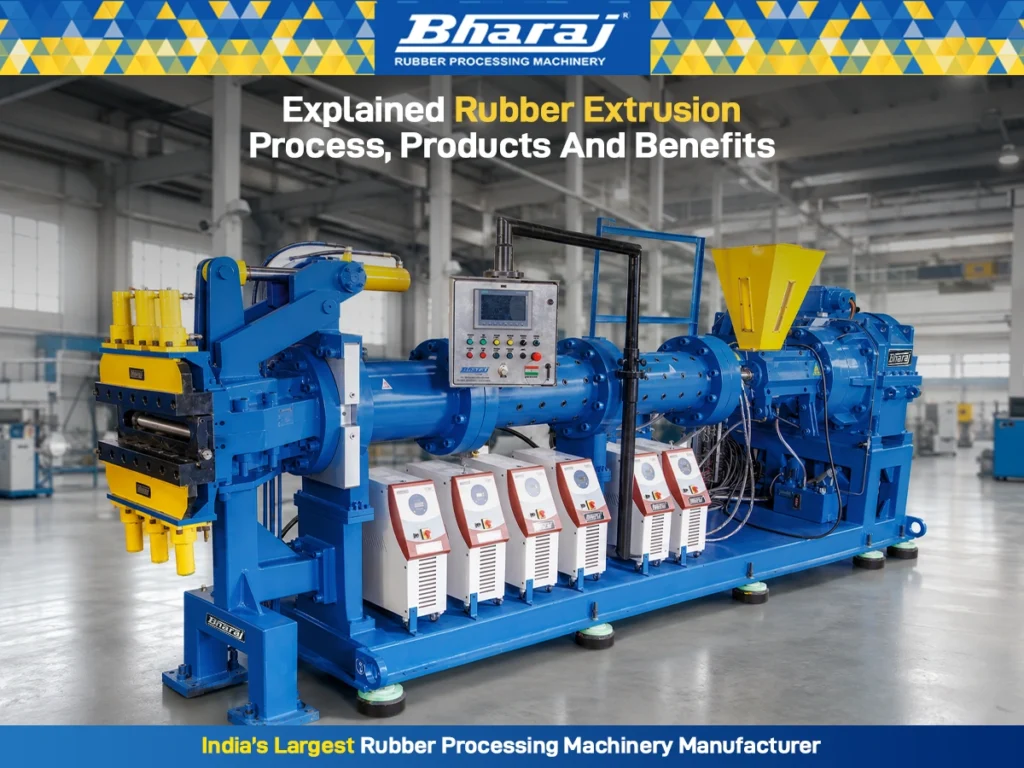
Explained Rubber Extrusion Process, Products And Benefits
Rubber components are used in almost every industry, from automotive and construction to healthcare, aerospace, and consumer goods. However, producing high-quality rubber profiles, tubes, hoses, seals, and gaskets requires more than quality raw materials. It depends on a controlled manufacturing method that delivers precision, consistency, and efficiency. This is where rubber extrusion plays a vital role. By forcing prepared rubber compounds through specially designed dies, manufacturers can produce continuous profiles with uniform dimensions, excellent surface finish, and minimal material waste.
As production standards become more demanding, selecting the right rubber extruder and processing technology has become increasingly important. Modern extrusion machines offer improved temperature control, higher output, energy efficiency, and greater automation, enabling manufacturers to produce complex rubber components with consistent quality. Drawing on industry expertise and engineering solutions from Bharaj Machineries, this guide explains how the extrusion process works, the different machine types available, and why extrusion remains one of the most efficient manufacturing methods for rubber products.
From Compound To Component
Rubber extrusion is a continuous manufacturing process in which a prepared rubber compound is pushed through an extrusion die to create products with a fixed cross-sectional profile. Unlike molding processes that produce individual parts, extrusion generates continuous lengths that can later be cut, cured, or assembled according to production requirements.
The process is widely used for manufacturing:
- Rubber hoses
- Window and door seals
- Weather strips
- Gaskets
- Cable insulation
- Industrial tubing
- Automotive profiles
- Tyre components
Because the material flows continuously through the die, manufacturers achieve consistent dimensions, reduced waste, and excellent production efficiency.
How The Rubber Extrusion Process Works
Although different applications require specific machine configurations, the overall extrusion process generally follows these stages:
1. Compound Preparation
Rubber is first blended with fillers, oils, curing agents, pigments, and performance additives to achieve the required physical properties. Proper compound preparation directly affects extrusion quality.
2. Feeding The Extruder
The prepared compound enters the extruder through a specially designed feeding arrangement. Feed rollers and spiral undercut systems ensure steady material intake while preventing interruptions during production.
3. Plasticising And Pressure Build-Up
Inside the barrel, the rotating screw compresses, mixes, and plasticizes the rubber while gradually building pressure. Temperature-controlled barrels maintain ideal processing conditions to prevent overheating and ensure smooth material flow.
4. Die Forming
The pressurized compound passes through a precision-engineered die that determines the final cross-sectional shape. Whether producing tubes, seals, hoses, or profiles, die accuracy directly influences dimensional consistency.
5. Cooling And Vulcanisation
After leaving the die, the extruded profile is cooled and then vulcanized or cured, giving the product its final strength, elasticity, and durability.
Choosing The Right Extrusion Technology
Every manufacturing plant has unique production requirements. Instead of relying on a single machine design, manufacturers often choose between different rubber extrusion machines based on product type, production volume, and compound characteristics.
Hot Feed Extruders
Hot feed systems continue to be widely used for many industrial rubber applications. These machines process pre-heated rubber compounds using relatively shorter screws and are well suited for continuous production.
Modern hot feed systems incorporate the following:
- Two-stage helical gearboxes for higher transmission efficiency
- EN-41B nitrided screws and liners for improved wear resistance
- Jacketed barrels for heating and cooling
- Feed roll arrangements that ensure smooth strip feeding
- Variable drive systems for consistent production performance
For harder rubber compounds, lower screw speeds combined with higher motor power help maintain stable processing conditions while preserving product quality.
Cold Feed Extruders
The cold-feed rubber extruder has become increasingly popular because it processes rubber directly at room temperature without requiring a warming mill. This simplifies production while reducing labor requirements and energy consumption.
Modern cold feed machines offer several operational benefits:
- Automatic temperature control
- Pressure monitoring through melt transducers
- Touch-screen operation
- Multi-zone heating and cooling systems
- Higher dimensional accuracy
- Consistent extrusion pressure
These features make cold feed systems particularly suitable for manufacturing industrial hoses, automotive hoses, tire treads, dock fenders, and various rubber profiles.
Where Extrusion Products Are Used
The versatility of extrusion makes it one of the most widely adopted manufacturing processes across industries. Since extruded profiles can be produced in continuous lengths with consistent dimensions, manufacturers can create components that require excellent sealing performance, flexibility, abrasion resistance, and long service life.
Some of the most common products manufactured using a rubber extruder include:
- Automotive radiator and fuel hoses
- A/C insulation tubes
- Tyre treads
- Dock fenders
- Industrial rubber profiles
- Weather seals and window gaskets
- Cable insulation
- Rubber tubing
- Conveyor belt components
- Expansion joints
- Custom rubber strips and seals
Because extrusion allows different die profiles, manufacturers can easily produce both standard and highly customized rubber components while maintaining consistent quality across large production batches.
Why Manufacturers Prefer Rubber Extrusion In India
For many industrial applications, extrusion offers significant advantages over molding and other forming methods. Continuous production reduces manufacturing time while ensuring excellent dimensional accuracy and repeatability.
Some of the major benefits include:
- High production speed for continuous manufacturing
- Uniform product dimensions and surface finish
- Lower material wastage
- Cost-effective tooling for long profiles
- Excellent flexibility in profile design
- Suitable for both simple and complex cross-sections
- Easy integration into automated production lines
- Consistent product quality across high-volume production
These advantages make extrusion particularly valuable for manufacturers producing long rubber profiles, tubing, sealing systems, and industrial hoses.
Features That Improve Extrusion Performance
Selecting the right Rubber extrusion machines involves more than choosing output capacity. Engineering features directly influence productivity, product quality, and maintenance requirements.
Modern industrial extruders typically include the following:
| Feature | Production Benefit |
|---|---|
| Jacketed barrels | Accurate heating and cooling throughout extrusion |
| Variable speed drives | Better process control for different rubber compounds |
| Hardened screws and liners | Improved wear resistance and longer service life |
| Feed roll arrangement | Smooth and consistent material feeding |
| Automatic temperature control | Stable extrusion quality with minimal operator intervention |
| Pressure monitoring systems | Consistent extrusion pressure and dimensional accuracy |
Machines incorporating these technologies help manufacturers minimize downtime while maintaining stable production conditions.
Choosing The Right Rubber Extruder
When investing in extrusion equipment, manufacturers should evaluate the complete production process instead of focusing only on machine size.
Important selection factors include the following:
- Production capacity per hour
- Type of rubber compound being processed
- Required product profile
- Temperature control capability
- Screw design and L/D ratio
- Automation and monitoring systems
- Maintenance accessibility
- Energy efficiency
- Future production expansion
Working with experienced manufacturers also ensures access to technical guidance, machine customization, spare parts availability, and long-term service support, all of which contribute to higher operational reliability and better return on investment.
Selecting The Right Extrusion Solution
Investing in the right extrusion system goes beyond comparing production capacity or motor power. Manufacturers should evaluate the type of rubber compound, desired output, automation requirements, maintenance needs, and long-term operating costs. The correct machine improves productivity, reduces material waste, and delivers consistent product quality over years of operation.
When comparing extrusion equipment, consider the following factors:
- Production volume and output requirements
- Type of rubber compounds being processed
- Temperature control capability
- Screw design and L/D ratio
- Automation and process monitoring
- Ease of cleaning and maintenance
- Energy efficiency
- Availability of technical support and spare parts
Working with experienced extruder manufacturers also helps ensure the equipment matches both present production needs and future expansion plans.
Summary
The success of any rubber manufacturing operation begins with selecting the right processing technology. A well-designed rubber extrusion system ensures consistent product dimensions, efficient material flow, lower production costs, and reliable long-term performance. Whether manufacturing industrial hoses, tire components, seals, tubing, or specialized profiles, the right equipment directly influences product quality and production efficiency. Modern rubber extrusion machines equipped with advanced temperature control, precision feeding systems, and efficient drive technologies allow manufacturers to meet growing production demands while maintaining high quality standards.
With decades of engineering expertise, Bharaj Machineries offers a complete portfolio of hot feed, cold feed, and pin-type extrusion systems designed to address a wide range of industrial applications. Their focus on robust construction, energy-efficient operation, process consistency, and advanced automation helps manufacturers achieve higher productivity while producing reliable rubber components that meet evolving industry requirements.
FAQs:
1. What is rubber extrusion used for?
Rubber extrusion is used to manufacture continuous products such as hoses, seals, gaskets, tubing, weather strips, tire components, and industrial profiles.
2. What is the difference between hot feed and cold feed rubber extruders?
Hot feed extruders process pre-heated rubber compounds, while cold feed extruders process rubber at room temperature, reducing energy consumption and eliminating warming mills.
3. Why are rubber extrusion machines preferred for industrial production?
They offer continuous manufacturing, consistent dimensions, reduced material waste, high productivity, and cost-effective production.
4. Which industries commonly use rubber extruders?
Automotive, construction, electrical, HVAC, marine, footwear, industrial equipment, and rubber component manufacturing industries widely use rubber extruders.
5. What should buyers consider before purchasing a rubber extruder?
Production capacity, screw design, temperature control, automation features, maintenance requirements, energy efficiency, and after-sales support should all be evaluated before selecting an extrusion system.